郑州大学郝新奇/张田原/朱新举Green Chem.:咪唑[1,2-a]吡啶的可切换电还原C3或C3,C5氘代反应
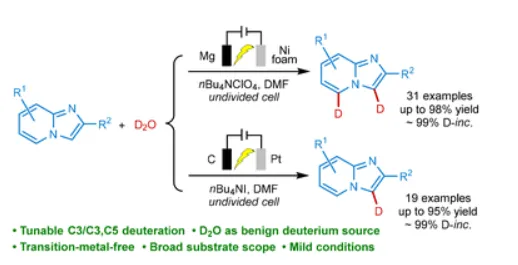
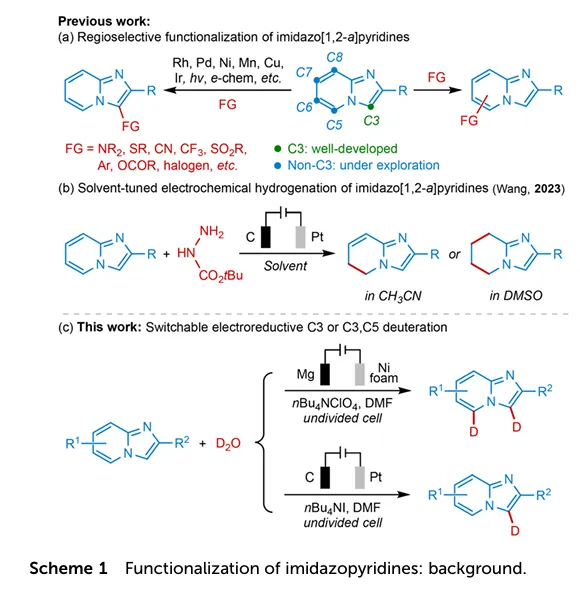
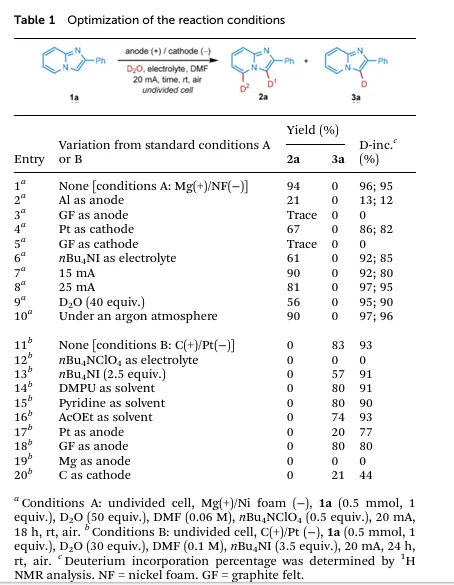
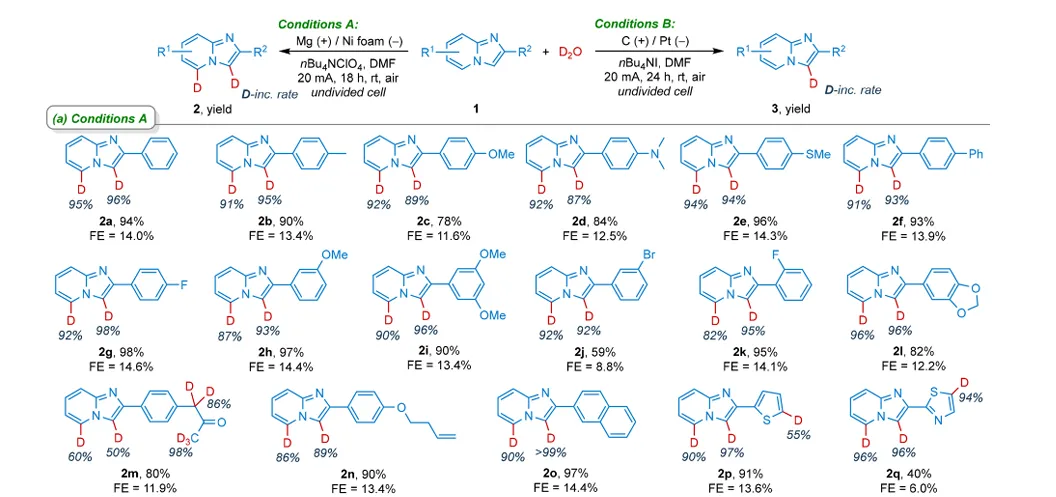
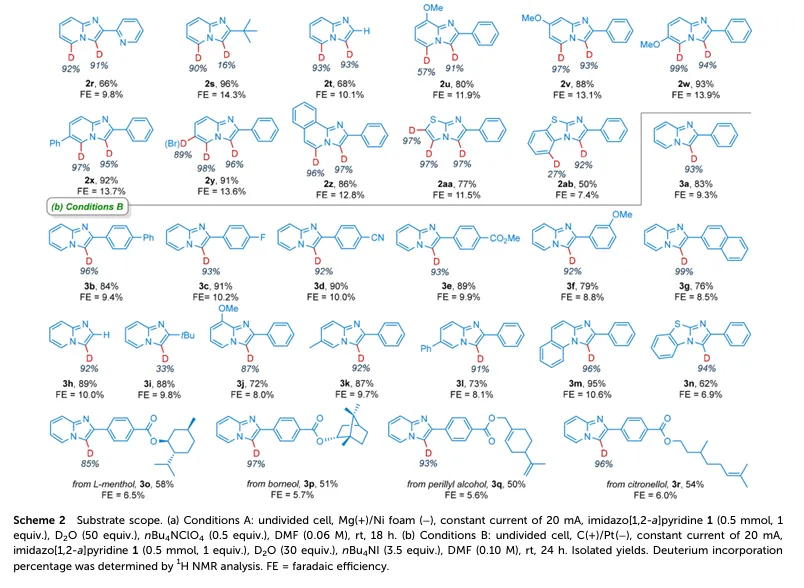
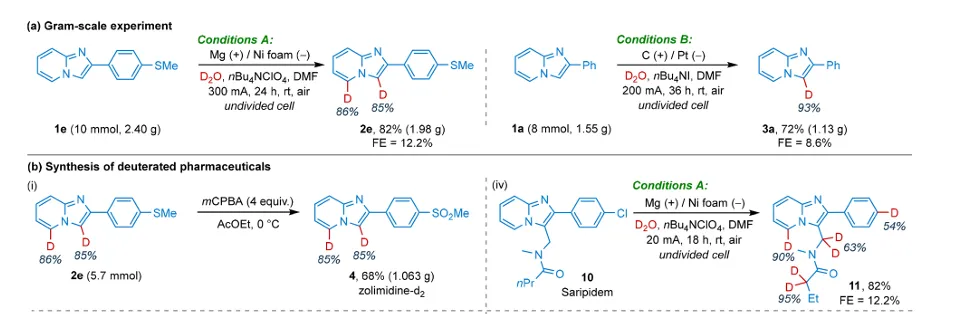
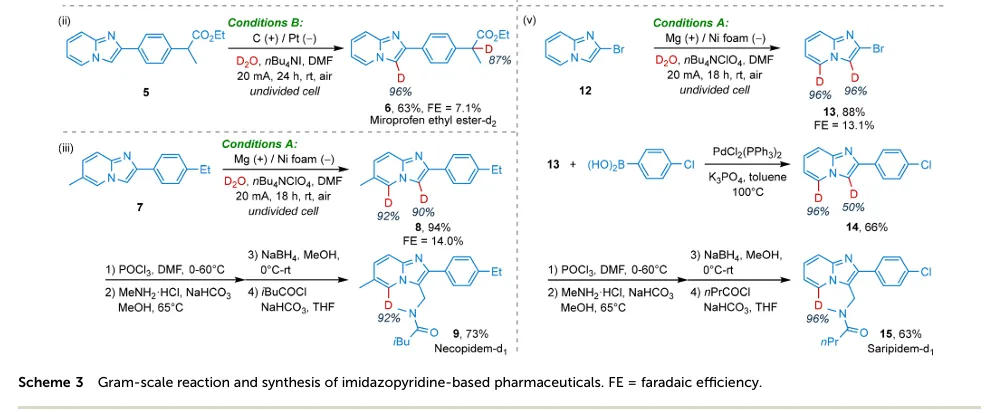
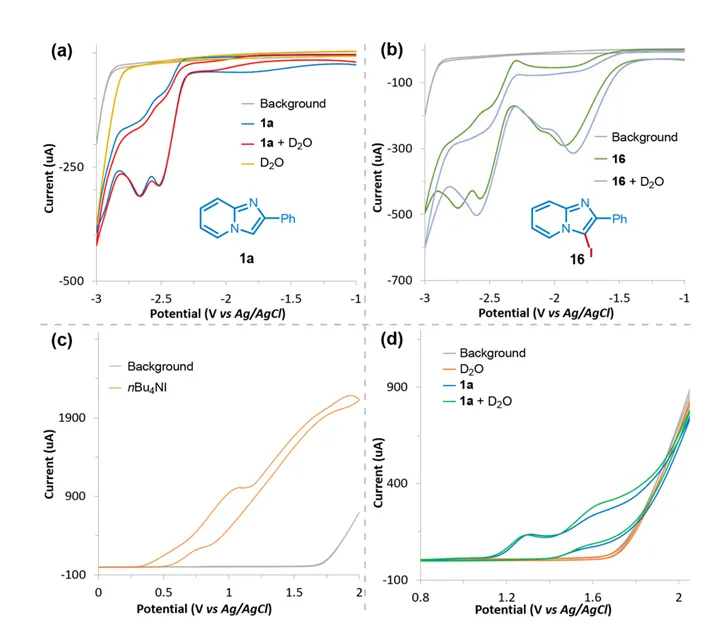
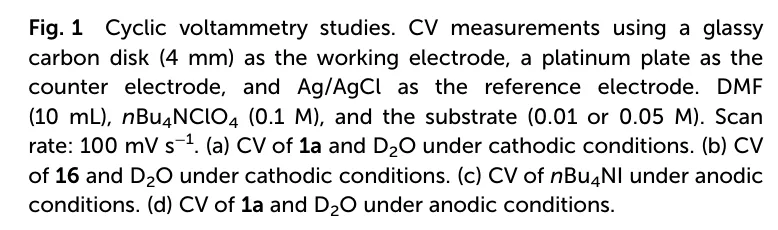
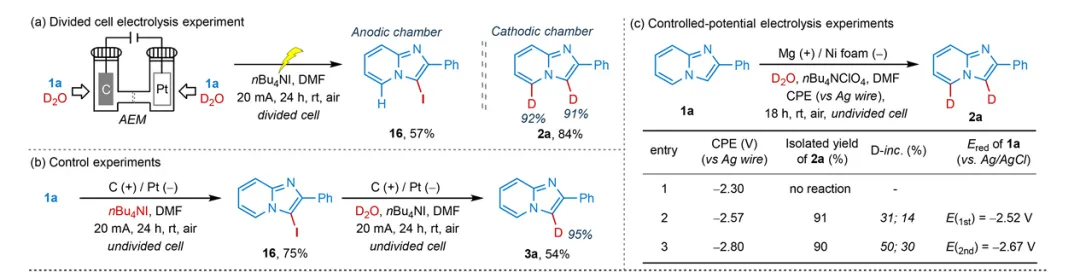
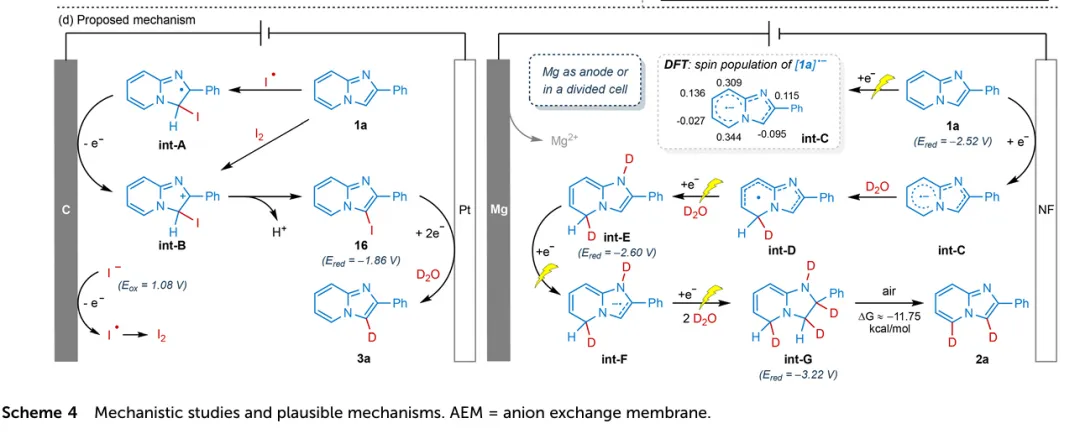
图1. TOC (图片来源于Green Chem.)A practical and scalable electrochemical protocol has been developed for the regioselective deuteration of imidazo[1,2-a]pyridines using D2O as the deuterium source. This transition-metal-free strategy enables selective C3 or C3,C5 deuteration under mild conditions, with the regioselectivity controlled by the choice of electrode materials and supporting electrolyte. The method demonstrates broad substrate scope, high deuterium incorporation, and excellent functional group tolerance. Notably, deuterated imidazopyridine-based pharmaceuticals, including zolimidine-d2, necopidem-d1, and saripidem-d1 were selectively synthesized using this approach. A plausible reaction mechanism is proposed based on control experiments and cyclic voltammetry studies.图2. 研究背景及本策略 (图片来源于Green Chem.)图3. 条件优化 (图片来源于Green Chem.)图4. 底物拓展 (图片来源于Green Chem.)图5. 克级反应及合成咪唑吡啶骨架药物分子 (图片来源于Green Chem.)图6. 循环伏安法研究 (图片来源于Green Chem.)图7. 机理研究及可能的催化循环 (图片来源于Green Chem.)In summary, a practical and scalable electrochemical protocol for the regioselective deuteration of imidazo[1,2-a]pyridines has been developed.By tuning the electrode materials and supporting electrolyte, either C3 mono-deuteration or C3,C5 bis-deuteration can be achieved under mild, transition-metal free conditions using D2O as the deuterium source. The method demonstrates broad substrate scope, high yields, and excellent deuterium incorporation. Deuterated imidazopyridine-based pharmaceuticals, including zolimidine-d2, necopidem-d1, and saripidem-d1 were selectively synthesized using this approach. Current efforts are focused on extending the methodology to incorporate additional types of electrophiles.
 10个月宝宝每天需要喝多少奶粉?

