一、成果简介
低维金属卤化物因其自陷激子(STE)产生的强热猝灭发光,在远程光学测温领域具有应用前景,但如何调控多个STE的热响应,并将其与深度学习结合以实现可靠的温度成像,仍是当前挑战。在这项工作中,研究人员揭示了Bi3+/Te4+共掺杂空位有序双钙钛矿中热激活的多激子脱陷动力学机制。通过调控BiCl6与TeCl6八面体的空间距离,在高温下实现了由Te4+诱导STE向Bi3+诱导STE的热致反向能量传递。变温拉曼光谱研究表明,在高Te4+掺杂浓度下,TeCl6相关的振动模式相较于SnCl6相关模式表现出更快速的热衰减,说明在升温过程中局部晶格的动态无序性加剧。这种热软化的配位环境增强了电子-声子耦合,促进了反向能量传递过程,最终导致Te4+相关STE发射发生快速热猝灭。基于上述机制,实现了对两个STE发射热响应的有效调控,并据此构建了高灵敏的比率型、荧光寿命型及比色型光学测温方法。进一步将显著的热致变色现象与基于卷积神经网络的深度学习图像分析相结合,建立了精确的比色测温平台,并将其应用于封装LED工作温度的实时测量,实现了1.12 °C的温度分辨率和毫秒级的响应时间。
二、图文导读
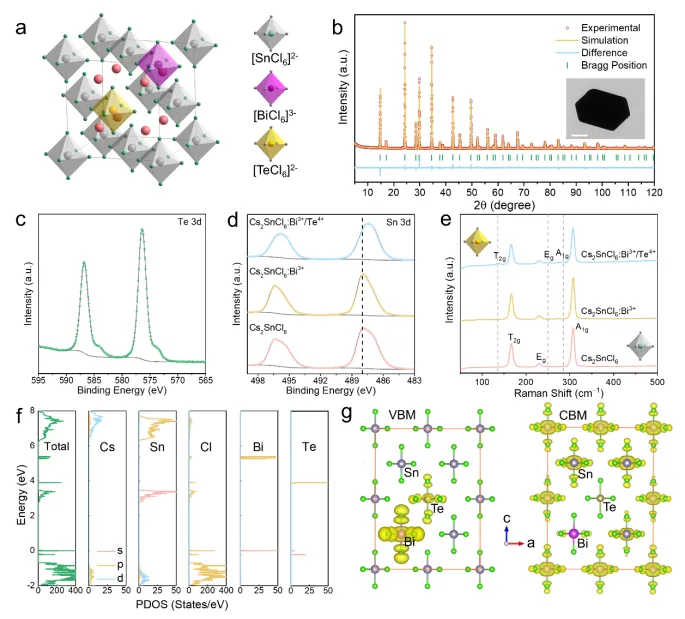
Figure 1. a) Schematic illustration of the crystal structure of Bi3+/Te4+-codoped zero-dimensional Cs2SnCl6. b) XRD pattern of Cs2SnCl6:5%Bi3+/4%Te4+ together with the Rietveld refinement. The inset shows a representative TEM image of a single crystal (scale bar: 1 μm). High resolution XPS spectra of c) Te 3d and d) Sn 3d. e) Raman spectra of pristine, Bi3+-doped, and Bi3+/Te4+-codoped Cs2SnCl6. f) CalculatedPDOS and g)charge density distributions for Cs2SnCl6:Bi3+/Te4+.
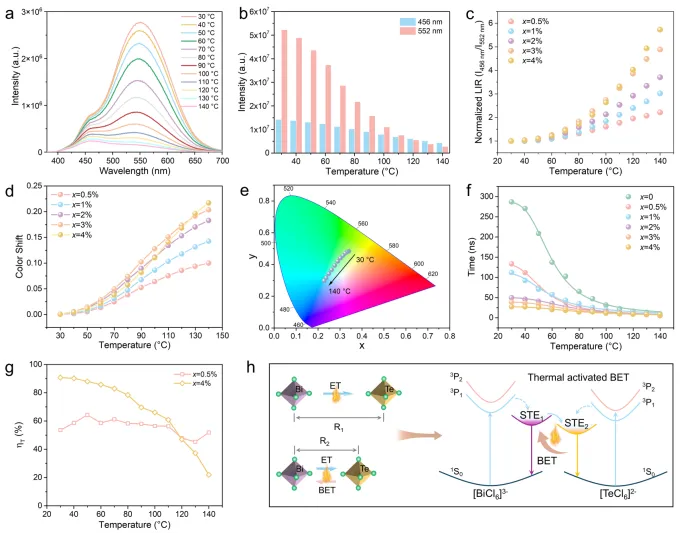
Figure 2. a) Temperature-dependent emission spectra and b) the corresponding integrated intensities of 456 nm and 552 nm emissions for Cs2SnCl6:5%Bi3+/4%Te4+. c) Temperature dependence of the normalized luminescence intensity ratio, and d) corresponding color shift values as a function of temperature for samples with different Te4+ doping concentrations. e) CIE 1931 chromaticity diagram illustrating the continuous thermochromic evolution of Cs2SnCl6:5%Bi3+/4%Te4+. f)Temperature-dependent fluorescence lifetimes of the 456 nm emission for Bi3+-only doped and Bi3+/Te4+ co-doped samples. g)Calculated energy transfer efficiency (ηT) from Bi3+-induced STE to Te4+-induced STE at different temperatures for representative low and high Te4+ doping concentrations. h)Schematic illustration of the multiexcitonic de-trapping dynamics, including forward energy transfer (ET) and thermally activated backward energy transfer (BET).
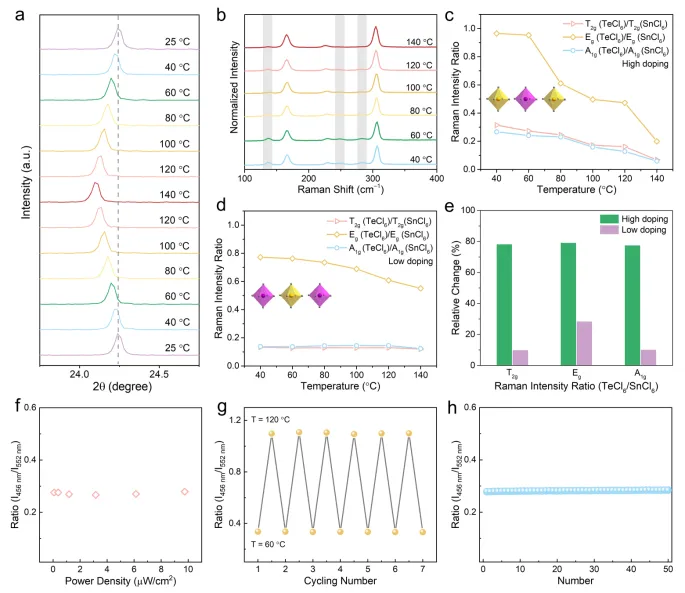
Figure 3. a) Temperature-dependent peak position of the (220) reflection extracted from the XRD patterns of Cs2SnCl6:5%Bi3+/4%Te4+ during heating and cooling cycles. b) Temperature-dependent Raman spectra of Cs2SnCl6:5%Bi3+/4%Te4+. Ratios of integrated Raman intensities between TeCl6- and SnCl6-related modes at different temperatures for c) high 4%Te4+doping and d) low 1%Te4+ doping samples. e) Thermally induced relative changes of Raman intensity ratio between TeCl6- and SnCl6-related modes. f)Stability of I456 nm/I552 nm under varying excitation power densities, g)reversibility of I456 nm/I552 nm during heating-cooling cycles, and h)continuous measurements of I456 nm/I552 nm for Cs2SnCl6:5%Bi3+/4%Te4+.
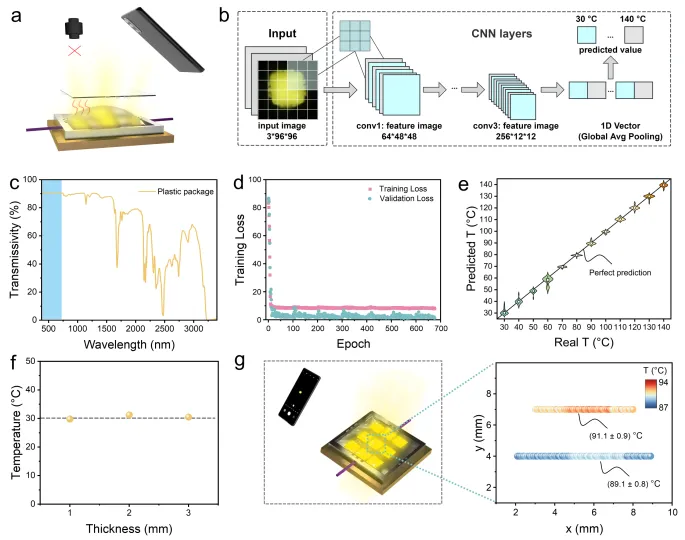
Figure 4. a) Schematic illustration of colorimetric thermometry, highlighting the limitation of commercial infrared thermal imaging for encapsulated LED devices. b) Schematic representation of the implemented convolutional neural network (CNN) architecture. c) Transmissivity spectrum of the plastic encapsulation. d) Loss function for the trained algorithm. e) Comparison between predicted temperature and real temperature. f) Temperature identification across varying coating thicknesses. g) Demonstration of spatial temperature mapping of an LED device based on luminescence imaging, with temperatures extracted from localized regions.
三、论文信息
Modulating Thermally Activated Multiexcitonic De-Trapping in Zero-Dimensional Tin-Halide Perovskites for Deep-Learning-Assisted Temperature Mapping
Mochen Jia, Zhe Wang, Zichen Bai, Zibin Liu, Mengya Li, Zhuangzhuang Ma, Ying Liu, Linyuan Lian, Jibin Zhang, Yanbing Han, Dongwen Yang, Mengyao Li, Xu Chen and Zhifeng Shi
First published: 25 February 2026, https://doi.org/10.1002/adfm.202532152